

Tungsten vs Lead Fishing Weights: Is the Switch Worth It?

Lead has been the default fishing weight material for decades. It's cheap, it's soft, it's easy to mold. But tungsten has been steadily replacing lead across competitive and recreational bass fishing — and the shift is accelerating. Multiple states have now banned lead tackle, tungsten prices have come down significantly, and anglers who make the switch almost never go back.
So is tungsten actually better, or is it just marketing hype? We've fished both materials extensively — our team is on the water every day in Tennessee — and the answer is clear. Here's the full breakdown.
Density and Size: The Core Advantage
This is where tungsten wins decisively, and everything else flows from it.
Tungsten is 1.7 times denser than lead and about 2.5 times denser than steel. In practical terms, a 3/8 oz tungsten weight is 30-40% smaller than a 3/8 oz lead weight. Same weight on your line, dramatically smaller profile in the water.
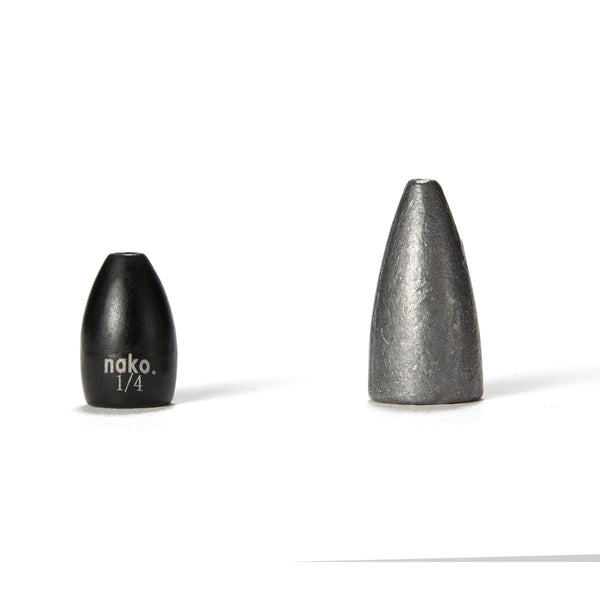
Why does size matter? A smaller weight slides through cover — rocks, brush, grass — without hanging up as often. It presents more naturally to the fish. And when you're punching through a grass mat, every fraction of an inch matters for clean entry.
The density numbers: lead sits at 0.410 lb per cubic inch, tungsten at 0.70 lb per cubic inch. That's not a marginal difference — it's a fundamental material advantage that affects every aspect of performance.
Sensitivity: Feel the Bottom, Feel the Bite
This is the reason tournament anglers switched to tungsten first, and it's the reason they'll never switch back.
Tungsten is significantly harder than lead. When your weight contacts the bottom, a hard material transmits vibrations up your line efficiently — you feel every rock, stump, gravel transition, and shell bed. Lead is soft and absorbs those vibrations. The difference is like listening to music through a wall versus through a window.
With tungsten, you can distinguish between mud, sand, gravel, rock, and wood — each has a distinct feel that tells you what kind of structure you're fishing. That information is critical for finding where bass are positioned. A gravel-to-mud transition on a point? That's a high-percentage spot, and tungsten lets you map it with your rod tip.
When a bass picks up your bait, tungsten transmits that subtle pressure change faster than lead. On a Texas rig or drop shot, that fraction of a second can be the difference between a hookset and a missed fish.
Fall Rate: Faster and Straighter
Take a 1/2 oz tungsten weight and a 1/2 oz lead weight. Same weight — but the tungsten falls faster. Why? It's smaller, so it has less surface area creating drag as it sinks. Less drag means a faster, straighter drop to the bottom.
This matters most in two situations: when you're flipping to cover and need your bait to punch through quickly before a bass loses interest, and when you're fishing deep water where a slow fall costs you time and bottom contact.
Lead weights also tend to have rougher quality control — jagged edges and inconsistent shapes create unpredictable drag. Tungsten holds tighter tolerances, so your drop is consistent cast after cast. Lead's rough edges also wear out your fishing line faster, especially fluorocarbon, which is already more brittle than braid.
Durability: Tungsten Lasts Longer
Lead is soft. It deforms when it hits rocks, gets gouged when it drags across gravel, and chips on hard structure. A lead weight that started as a smooth bullet can look like a misshapen blob after a day of fishing rocky bottom.
Tungsten holds its shape. It's one of the hardest metals available, rating 7.5 on the Mohs scale compared to lead's 1.5. Your tungsten weight looks the same after 100 casts as it did on the first. That consistency means consistent performance — same fall rate, same profile, same feel throughout the day.
Environmental Impact: The Legal and Ethical Case
This is no longer just an ethical consideration — it's becoming a legal one.
Lead is toxic to waterfowl, raptors, and aquatic ecosystems. When a bird ingests a lost lead weight, it can cause lead poisoning and death. The science is well-established and the regulatory response is accelerating:
New York banned lead fishing tackle under 1 oz in freshwater (effective 2025). Massachusetts restricts lead sinkers under 1 oz in all state waters. New Hampshire bans lead sinkers and jigs weighing 1 oz or less. Maine, Vermont, and Washington have similar restrictions in place or pending. The EPA and multiple conservation organizations are pushing for federal regulation.
If you fish in multiple states — especially in the Northeast — switching to tungsten now means you're already compliant. And even in states without current bans, the writing is on the wall. Lead restrictions have only ever expanded, never been rolled back.
Beyond compliance, it's about being a responsible steward of the water. If you love fishing, protecting the ecosystems that make it possible isn't optional — it's part of the sport.
Cost: The Gap Is Closing
The traditional argument against tungsten has always been price. And yes — tungsten is more expensive than lead. A 5-pack of tungsten worm weights runs $6-8 compared to $2-3 for lead.
But the gap has narrowed significantly over the past few years. Brands like Nako have used direct supply chain relationships to bring tungsten prices down to levels that were unthinkable five years ago. A pack of tungsten flipping weights for $7.99 is a different conversation than $15-20, which is what tungsten cost from premium brands just a few years ago.
Factor in durability — tungsten weights don't deform and last longer — and the cost per fishing trip gets even closer. And if you're losing fewer fish because of better sensitivity, the value equation shifts entirely.
For anglers ready to commit fully, our tungsten weight kits (100-200 pieces) bring the per-weight cost down another 20%+ compared to buying individual packs.
When Should You Switch?
Not everyone needs to go all-tungsten overnight. Here's a practical approach:
Start with the techniques where tungsten makes the biggest difference. Drop shot and flipping benefit the most from tungsten's sensitivity and compact size. If you only switch two categories, make it these two.
Texas rig worm weights are the next priority — you throw them more than anything else, and the sensitivity upgrade on the bottom is immediately noticeable.
Keep lead for applications where sensitivity matters less and loss rate is high — deep cranking weights, trolling sinkers, and catfish rigs where you're not feeling for subtle bites.
Once you've fished tungsten for a week, the decision usually makes itself. The feel difference is that dramatic.
The Bottom Line
Tungsten outperforms lead in density, sensitivity, fall rate, durability, and environmental impact. Lead's only remaining advantage is price — and that gap is closing fast.
If you're a serious bass angler, the question isn't whether to switch. It's how quickly you can fill your tackle box with tungsten and start feeling what you've been missing.
Leave a comment